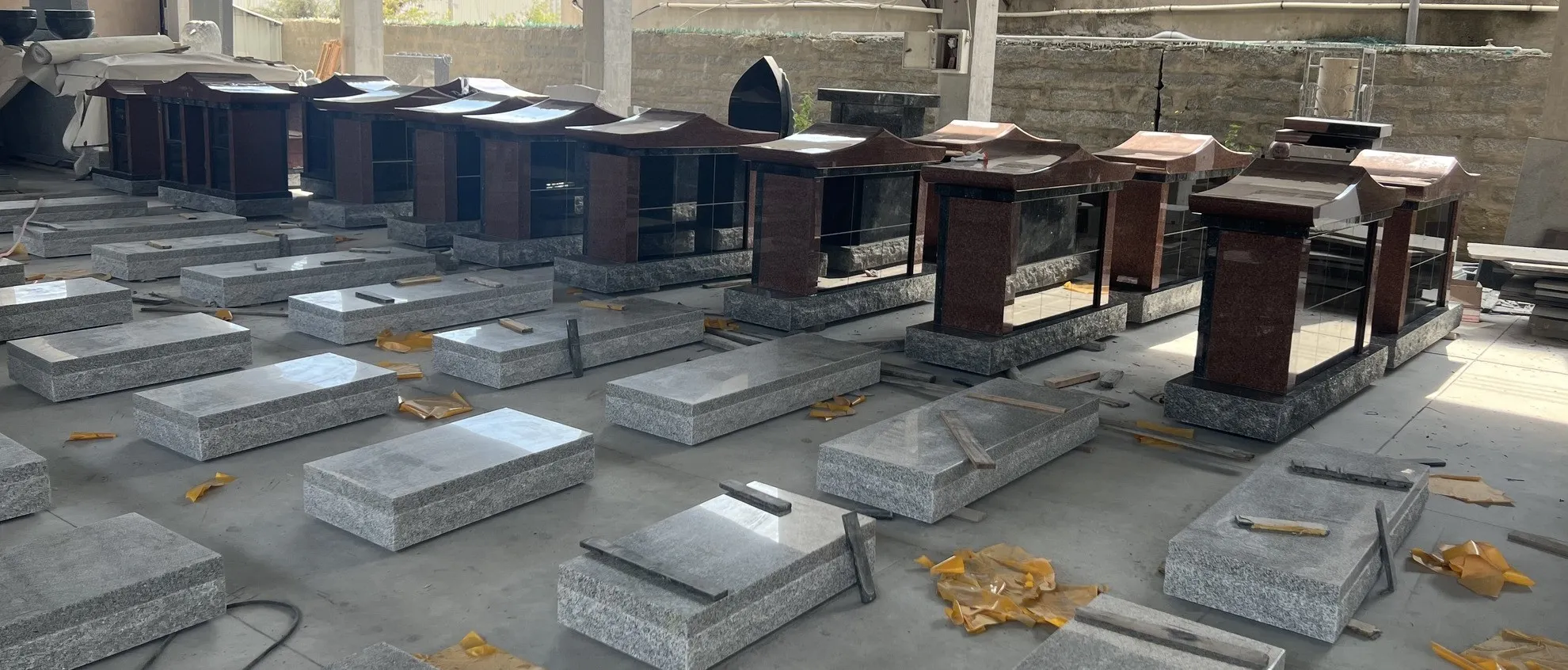
Wholesale Granite Grave Ledgers
Boda Stone supplies wholesale granite grave ledgers for monument dealers, importers and memorial trade buyers. Depending on local catalog usage, the format may be called a grave ledger, ledger headstone or full-length grave cover stone. Send the approved footprint, thickness, profile, piece layout, stone, finish, lettering scope, foundation and destination for an engineering, packing and loading review.
B2B boundary: the buyer confirms current cemetery terminology, grave-space dimensions, foundation, lifting, installation and local safety requirements. No universal ledger size or installation method is assumed.
Grave Ledger, Grave Cover or Flat Marker?
In North American usage, a grave ledger generally covers most or all of the grave footprint. A flat marker is normally a smaller flush or low-profile memorial. Dealers may also use “grave cover” or “ledger stone.”
Names vary by cemetery and region. Quote and production should follow the approved footprint, section rules and drawing rather than a product label alone.
One Piece or Multiple Pieces
A one-piece ledger can reduce visible joints but may increase weight, handling and shipping constraints. A multi-piece layout can change joint location, support, drainage, marking and installation work.
The practical layout is confirmed only after stone availability, overall size, thickness, gross weight, lifting access, foundation and route limits are reviewed.
Granite Grave Ledger Specification Checklist
Large cover stones require order-specific drawings, handling information and clear responsibility boundaries.
| Specification | What to confirm |
|---|---|
| Overall footprint | Cemetery-approved length and width, grave-space clearance, orientation and relationship to any headstone, base, curb or vase. |
| Piece layout | One-piece or multi-piece arrangement, joint locations, piece marks, assembly sequence and any separate inscription panel. |
| Thickness and profile | Nominal and minimum thickness, flat, bevelled, crowned or sloped surfaces, edge profiles, radii and permitted tolerances. |
| Stone and finish | Granite designation, acceptable color range, polished, honed, steeled, sanded, sawn or rock-pitched areas shown on a finish map. |
| Lettering and features | Blank or factory-lettered status, proof, portraits, emblems, drainage details, vase or pin holes and attachment interfaces. |
| Foundation and support | Buyer-approved bearing and support arrangement, joint support, setting method and local installation requirements. |
| Handling | Piece weights, lifting access, equipment limits, protected surfaces and safe unloading or setting sequence. |
| Packing and loading | Crate design, face and edge protection, piece and crate marks, gross weights, loading route and destination constraints. |
Production and Export Controls
- • Review the approved drawings, piece layout and finish map before production
- • Check dimensions, thickness, profile, visible surfaces and lettering against agreed records
- • Use clear piece and crate marks for multi-piece grave ledger sets
- • Protect finished faces and edges according to the approved packing plan
- • Provide agreed inspection and loading evidence for the actual order
Cemetery and Installation Inputs
- • Confirm the cemetery accepts a ledger or full grave cover in the selected section
- • Approve grave-space dimensions, foundation, support and drainage requirements
- • Confirm local lifting, setting, joint and worker-safety procedures
- • Approve natural stone color range and any sample or slab-selection requirement
- • Confirm import, delivery and installation access at the destination
Define the Approval and QC Records
Drawings, measurements and packing records should be agreed for the actual order rather than copied from an unrelated monument program.
Drawing approval
Confirm views, dimensions, profiles, finishes, holes, artwork and piece marks before production.
Measurement and QC
Agree checks for size, stone lot, finish, flatness, edges, lettering and component fit.
Crates and loading
Confirm face protection, crate marks, gross weights, packing list and loading evidence.
Send a Grave Ledger Drawing
A cemetery-approved drawing and handling plan are more useful than asking for a standard ledger size.
Send a Grave Ledger Drawing- Overall footprint and thickness
- One-piece or multi-piece layout
- Granite and finish map
- Blank or personalized scope
- Foundation and lifting inputs
- Destination port and Incoterm
Wholesale Granite Grave Ledgers FAQ
- What is the difference between a grave ledger and a flat grave marker?
- A grave ledger generally covers most or all of the grave footprint, while a flat marker is usually a smaller flush or low-profile memorial. Cemetery terminology varies, so the approved dimensions and section rules control the order.
- Can a granite grave ledger be made as one piece or several pieces?
- Both layouts may be reviewed. The practical arrangement depends on overall dimensions, thickness, stone availability, weight, foundation support, lifting access, installation method and shipping limits.
- Can grave ledgers be supplied blank or factory-lettered?
- Yes. State whether the ledger is blank for local work or personalized from an approved proof. Also identify emblems, portraits, inscriptions, drainage features, vase holes and any separate headstone components.
- Are there standard grave ledger dimensions?
- There is no single universal size. Send the cemetery-approved length, width, thickness, profile, foundation and installation requirements for the actual grave space and market.
- How are large granite grave ledgers packed for export?
- The packing plan is based on the actual piece sizes, gross weights, finished surfaces, lifting points, crate design and loading route. Multi-piece sets should use clear piece and crate marks.
Prepared by the Boda Stone Monument Product Team · Reviewed by the Monument Production & Export Team · Updated