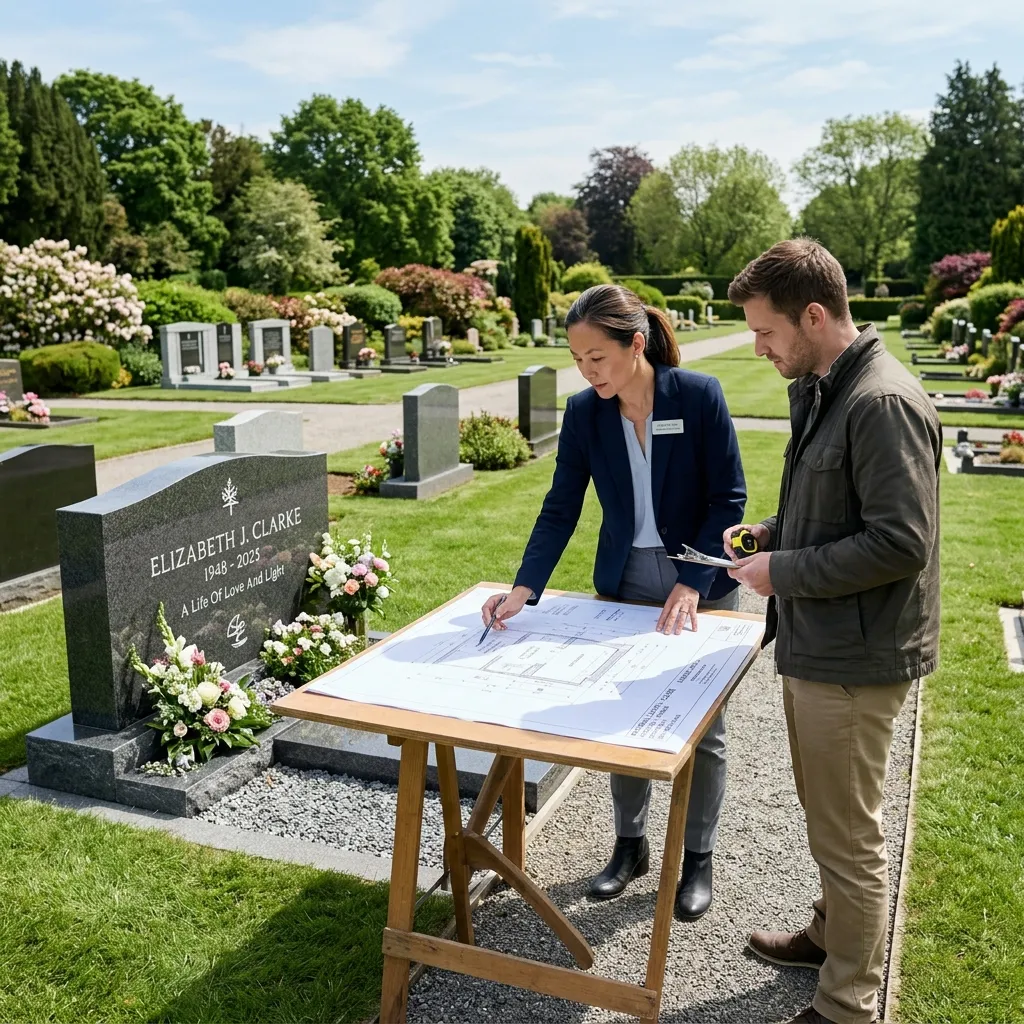
Ask the cemetery which dimensions it permits for the specific plot. Confirm whether a height limit includes the base, and show each component on the drawing. Mark inches or millimetres clearly. Common catalogue sizes and US government marker dimensions are not blanket approval for private cemeteries.
What determines the final dimensions
| Control | Evidence |
|---|---|
| Plot and cemetery section | Current cemetery rule or application form |
| Monument type | Approved upright, slant, bevel, flat or other drawing |
| Foundation | Required size, projection and installer responsibility |
| Base and accessories | Allowed dimensions, vase location and clearances |
| Installation | Permit, approved installer and seasonal conditions |
How to use published government sizes
The US Department of Veterans Affairs publishes dimensions for government-furnished headstones and markers. Those values apply to the stated program and products. They are not a general sizing rule for all private cemeteries, Canadian cemeteries or custom memorials.
Steps before you place the order
- Collect the cemetery rule and plot information.
- Prepare the full drawing with base and foundation relationship.
- Confirm lettering and accessory limits.
- Obtain written approval.
- Use the approved drawing for factory and pre-shipment inspection.
What to include in a U.S. or Canadian quote request
For a usable factory quotation, a buyer should send more than a width and height. The site rule, base relationship and installation context determine whether a nominal size can actually be produced and installed.
| Field | Buyer should provide |
|---|---|
| Site and market | US or Canadian province/state, cemetery, section, plot type and approval contact |
| Monument configuration | Upright, flat, bevel, slant or custom type; die, base, vase and accessory relationship |
| Dimensions | Width, height, thickness, base, projection, clearances and unit system |
| Foundation and fixing | Required foundation size, anchor or dowel details, installer and inspection responsibility |
| Finish and inscription | Stone, surface, lettering, artwork, proof language and cemetery restrictions |
What the factory can and cannot decide
Boda Stone can check whether the approved drawing is manufacturable, identify missing dimensions, prepare a CAD revision and record the agreed stone, finish and artwork. The factory cannot approve a private cemetery, certify a foundation for every jurisdiction, or turn a VA program dimension into a universal private-market rule. The buyer and local cemetery or installer must resolve those points before production release.
Final checks before cutting
- Attach the current cemetery rule or written approval to the order.
- Show the monument, base, foundation relationship and accessories on one approved drawing.
- Confirm inch or millimetre units and any required corner, edge or anchor details.
- Approve inscription proof and material sample or lot reference.
- Use the approved revision for first-piece or pre-shipment inspection.
Send a drawing for a fit review
Send the cemetery drawing or dimensions with the country, cemetery, monument type, stone, finish, quantity, inscription, foundation notes and target delivery term. We can flag manufacturing questions while the local approval remains with the responsible cemetery or installer.
Frequently Asked Questions
What is the standard upright monument size?
There is no single size accepted by every cemetery; confirm the exact site rule.
Can VA marker dimensions be used for private orders?
Only when the relevant cemetery and order requirements accept them; VA specifications are program-specific.
Should the foundation appear on the factory drawing?
Show the monument-to-foundation relationship when it affects fit, projection or installation approval.
Sources and further reading
- VA/NCA — Types of Headstones and Markers: Government-furnished U.S. program formats, not universal private-cemetery dimensions.
- Bereavement Authority of Ontario — Bylaws: Ontario-specific guidance on cemetery bylaws; not a Canada-wide monument size standard.
Updated October 5, 2026. Check the current requirements for your destination and order.
A workshop example
See the drawings and workshop photos from our Rodrigues order. This is a company project example; the requirements for your order are agreed separately.